
The Real Differences Between I/O Psychology Career Paths (HR, T&D, Academia, Analytics, Selection & Recruitment, Culture Change)
Whether you are a new graduate or a transitioning professional, breaking into I/O Psychology can be a difficult task. In this article, I break down the field into its paths and discuss how to strategize your entry into each.
I/O PSYCHOLOGY
Jess Sumerak
4/1/20265 min read
The Real Differences Between I/O Psychology Career Paths (HR, T&D, Academia, Analytics, Selection & Recruitment, Culture Change)
I/O Psychology is often presented as one field, and in college, you get to explore each of these paths as if they are connected into one cohesive career. And while there is significant overlap, the strategy required to break into each of these areas is very, very different.
Each path has different expectations, barriers to entry, and day-to-day realities. If you don’t understand those differences early, it’s easy to apply the wrong strategy and feel stuck as you move forward.
So let’s walk through each path and what actually matters if you want to get ahead.
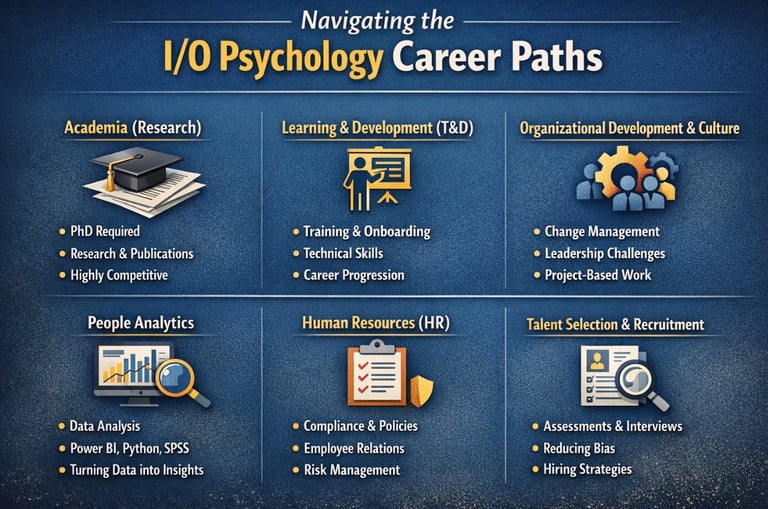
1. Academia (Research Track)
If you’re interested in academia, this path is heavily focused on research, publication, and statistical rigor.
Most roles require a PhD, and success is driven by your ability to conduct high-quality research, publish in peer-reviewed journals, secure funding or contribute to research programs (grant writing and persuasive communication are extremely valuable here), and teach and mentor students.
This is a highly competitive path with a limited number of roles relative to the number of qualified candidates.
It’s also important to understand that academia is not typically the highest-paying route, but it can be deeply fulfilling for those who enjoy research, theory-building, and contributing to the field at a foundational level.
If this path interests you, your focus should be on building a strong research portfolio (both qualitative and quantitative), getting involved in publications early, and networking within academic circles.
What you choose for your dissertation matters more than most people realize. It is influenced not just by your interests, but by ethics board constraints (which are often more complex than expected) and by what unanswered questions exist in the field.
Look at the journals you want to contribute to. Study what they publish, how they structure work, and what types of research they prioritize. Then align your efforts accordingly.
Academia is a close-knit space. Go to conferences, speak to professors after panels, introduce yourself, and build relationships early.
2. Learning & Development (Training & Capability Building)
Learning & Development is one of the most accessible entry points into applied I/O work.
Many early-career roles exist in training, onboarding, facilitation, and curriculum design. It’s also a great way to build strong presentation and communication skills early.
A common and often overlooked entry point is technical training. Organizations frequently need trainers for proprietary systems or internal processes, and they are willing to teach you the content if you can effectively teach others.
This makes it easier to get your foot in the door while building core I/O skills.
From there, progression often follows a path of increasing responsibility: Trainer → Senior Trainer → L&D Manager → Director.
In today’s market, advancement often happens within the same organization rather than through title jumping. Employers are looking for ownership of larger initiatives, measurable impact, and clear progression over time.
Key skills in this path include instructional design (higher compensation potential), facilitation (common entry point), LMS platforms, e-learning tools such as Articulate Storyline or Rise, and stakeholder communication.
Stakeholder communication becomes especially important at higher levels, where you need to interpret business needs, align training to organizational goals, and gain buy-in from leadership.
AI is becoming an expectation in this space, particularly at leadership levels. However, the market has not fully standardized how it is used. The advantage right now comes from understanding how to apply AI thoughtfully—not just using tools.
3. Organizational Development & Culture Work
This is the path many people are initially drawn to, including myself.
The idea of improving culture and building better workplaces is compelling.
But here’s what I learned the hard way:
Organizations almost never hire for “culture improvement.”
They hire when something is broken.
This work often exists in highly emotional environments and is evaluated based on how well your solutions are accepted by the people impacted. There are many variables to success, but a strong foundation in change management psychology is essential.
This includes navigating restructuring, leadership challenges, performance issues, and post-layoff stabilization.
Because of this, many roles are project-based, contract-focused, and tied to specific organizational needs.
Breaking into this space can be difficult without prior business experience, a track record of measurable outcomes, and exposure to real organizational problems.
A common entry point is through consulting firms, particularly if you can secure an internship that leads to full-time work.
Another approach is to specialize first (HR, operations, training, etc.) and then transition into broader organizational work later.
Certifications such as ICF coaching can strengthen your positioning, especially in leadership and development-focused roles.
4. People Analytics / Data-Focused Roles
This path focuses on using data to understand and improve workforce outcomes.
Typical responsibilities include analyzing employee data, building dashboards, interpreting survey results, identifying trends, and making recommendations.
Key skills include statistical analysis (SPSS, R, Python, depending on role), data visualization (Power BI, Tableau), survey design, and the ability to translate data into actionable insights.
This is a highly valuable area, but also increasingly competitive. As AI continues to evolve, expectations for technical capability are rising, while some roles are becoming more consolidated.
To be competitive, you need both strong analytical skills and the ability to communicate insights clearly to non-technical stakeholders. Data alone is not enough; interpretation is what creates value.
5. Human Resources (HR)
HR is always needed, with many clearly defined roles available, but it’s important to understand the reality of the work.
Many people enter HR wanting to help employees. In practice, HR operates within the structure of the organization and is responsible for compliance, policy enforcement, employee relations, and organizational risk management.
This often includes navigating difficult conversations, high-conflict situations, layoffs, and unpopular policy decisions.
Success in HR requires strong emotional regulation, deep knowledge of labor laws and regulations, experience with HR systems (HRIS), and the ability to balance employee needs with organizational priorities.
Certifications such as SHRM or HRCI are often expected and can strengthen your credibility.
6. Talent Selection & Recruitment
This area focuses on how organizations identify, evaluate, and hire talent.
It includes designing and implementing assessments, structured interviewing, reducing bias in hiring processes, and aligning hiring decisions with organizational needs.
This is one of the most impactful areas in I/O because it shapes the employee experience from the very first interaction.
Strong skills in this space include assessment design and validation, understanding bias and fairness, structured interview techniques, and alignment between role requirements and candidate evaluation.
In smaller organizations, this work is often embedded within HR roles rather than being a standalone position. This means reading job descriptions carefully to identify where these responsibilities exist.
Larger organizations may require deeper experience in recruiting lifecycle management and assessment design.
Final Thought
Broadly applying to all of these roles is not going to get you hired.
You need to build your path strategically toward the roles you want. Once you are established, you can expand.
But early on, clarity is what creates opportunity.
Need to create a strategy towards building your career? Check out more resources for people professionals here.
Intentional Empowerment, LLC
Empowering people-first, Research based, business strategy & employee well-being
© 2025 Intentional Empowerment. All rights reserved.
Follow us on social
Have a question? We're here to help.
📧 jsumerak@intentionalempowerment.com
📍 Twinsburg, OH (Serving clients nationwide)