
The Missing Piece in Organizational Change: Shared Responsibility
How to build values into the structure of your organization so they survive leadership change.
STRONG FOUNDATIONCULTUREWORK SMARTER
Jess Sumerak
4/23/20268 min read
There’s a word that gets thrown around in boardrooms, town halls, and job postings with such frequency, and such imprecision, that it has nearly lost all meaning.
That word is culture.
Before any organization launches a culture program, hosts a culture workshop, or proudly declares itself a “culture-first company,” there is one step that almost always gets skipped: defining what culture actually is.
And the only way to do that honestly is to start with what it isn’t.
Culture Is Not a Control Tactic
When leadership uses “culture” as a mechanism to enforce compliance, silence dissent, or pressure employees into conforming to arbitrary behavioral expectations, that isn’t culture, it’s control. Real culture does not require surveillance, threats, or manufactured loyalty. If the only way your culture survives is by suppressing the people within it, it isn’t culture. It’s a policy dressed up in warmer language.
Culture Is Not Vague, Subjective Guidelines
“We value passion.” “We move fast.” “We’re a family here.” These phrases are not cultural definitions, they’re abstractions that mean everything and nothing simultaneously. Subjective guidelines give leadership maximum flexibility and employees zero clarity. That imbalance isn’t cultural alignment; it’s plausible deniability.
Culture Is Not a Pizza Party
Free snacks, ping pong tables, and Friday happy hours are amenities. They can be lovely. They can even signal something about an organization’s values. But they are not culture. When perks are substituted for psychological safety, fair compensation, and genuine belonging, they become a distraction, and eventually, an insult.
Culture Is Not Unpaid Labor Dressed Up as Values
Unlimited PTO that is never actually approved is not a benefit, it’s theater. Suggestions (explicit or implied) that employees should work off the clock “because they care” is not culture, it’s wage extraction with a values pitch attached. Passion is not a currency. If the cultural expectation is that employees give more than they are compensated for, call it what it is. Don’t call it culture.
Culture Is Not a Hiring Filter for Bias
“Culture fit” has become one of the most misused phrases in talent acquisition. When it functions as code for hiring people who look, think, socialize, or background-check like existing leadership, it isn’t culture, it’s homogeneity. It forecloses the diversity of thought, experience, and perspective that makes organizations stronger. A culture worth building should expand who belongs, not quietly contract it.
So, What Is Culture, Actually?
Culture is the lived experience of what it means to work somewhere.
It is the gap, or the alignment, between what an organization says it values and what it actually rewards, tolerates, and models at every level. Culture is how decisions get made when no one’s watching. It’s who gets credit, who gets heard, and who gets protected when things go wrong.
Culture is built in the small, unscripted moments: how a manager responds to a mistake, whether a hard conversation happens or gets avoided, whether feedback flows in both directions. It lives in norms, not slogans.
Here is the simplest definition worth anchoring to:
Culture is the pattern of behaviors an organization consistently reinforces, through what it rewards, what it ignores, and what it refuses to tolerate.
That’s it. No ping pong required.
The organizations that get culture right don’t start with perks or taglines. They start with honesty about the gap between their stated values and their actual behavior. Then they do the hard, unglamorous work of closing it.
And that works starts by establishing a shared definition.
How to Actually Build Culture
Now that we know what culture is, and what it isn’t, the next question is the harder one: How do you build it?
The honest answer is that culture isn’t built with a campaign. It isn’t built in a workshop or handed down in a memo. Culture is built by embedding your values so deeply into the architecture of your organization that they outlast any single leader, survive turnover, and don’t depend on anyone remembering to enforce them. It becomes the way things are done because there is no other way.
That kind of durability doesn’t happen by accident. It requires intention at every level, from the first conversation with a candidate to the way performance is reviewed years later.
Here’s what that looks like using company values as an example.
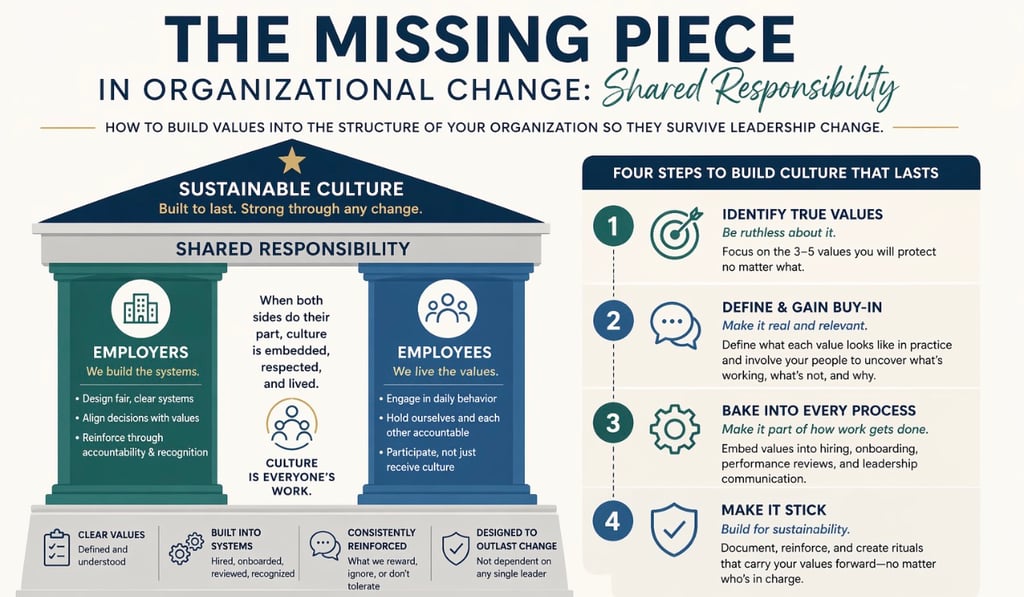
Step One: Identify Your True Values and Be Ruthless About It
Every culture-building effort must start here. Not with mission statements. Not with what sounds good on a careers page. With an honest answer to this question: What does this organization value most?
And then comes the harder discipline: cutting the list down.
It would be wonderful to build an organization that embodies twenty values simultaneously: integrity, innovation, collaboration, accountability, transparency, resilience, inclusion, and a dozen more. But an organization that tries to prioritize everything equally ends up prioritizing nothing. Values compete for resources, attention, and decision-making weight. When everything is a priority, leaders default to whatever is easiest or most comfortable in the moment. And the culture becomes whatever that is.
The goal is to identify your top three to five core values, the ones that, when forced to choose, your organization will protect above the others. These are the values that should be non-negotiable in hiring, non-negotiable in promotions, and non-negotiable in how leadership behaves when things get hard.
A practical starting point: Ask your leadership team independently: What are the three things we are unwilling to compromise on, no matter what? Compare the answers. Where there is overlap, you have the seed of a real value. Where there is disagreement, you have a values conversation that needed to happen a long time ago.
Step Two: Define What Each Value Actually Looks Like in Practice & Gain Buy-in
Once you have your values, you have to define them specifically. Not “we value integrity” but: What does integrity look like in a performance review conversation? In a sales negotiation? When a project is behind and someone is tempted to hide it?
Vague values are useless values. They become whatever anyone needs them to mean in a given moment, which means they mean nothing consistently.
For each core value, your organization should be able to answer:
- What behaviors demonstrate this value?
- What behaviors violate it?
- How do we recognize it when we see it?
- What do we do when someone doesn’t live it?
This is not a branding exercise. It is a behavioral contract, and it needs to be written in plain language that any new hire, front-line employee, or senior leader can read and immediately understand.
Let’s take a simple example: punctuality.
To define what punctuality means, we must align leadership first.
Start with a simple question:
“What does punctuality actually mean here?”
Is it:
Starting meetings exactly on time?
Meeting deadlines consistently?
Respecting others’ time across teams?
You’ll quickly realize that even something as straightforward as punctuality can mean different things to different people.
That lack of clarity is where culture breaks down before it even starts.
From there, the conversation needs to go deeper:
“Why does this matter to our business?”
If punctuality doesn’t connect to something real, client experience, operational efficiency, team trust, revenue flow, it won’t hold.
This is where buy-in actually happens, by connecting it to outcomes they already care about.
Next, once leadership is aligned, bring the broader organization into the conversation to understand the current reality.
This is where a simple pulse survey can be powerful:
Where do we currently demonstrate punctuality well?
Where do we fall short?
What gets in the way of being on time or meeting deadlines?
Where does it matter most in your day-to-day work?
What you’re doing here isn’t just gathering feedback.
You’re identifying friction.
Because if your systems make punctuality difficult, no amount of messaging will fix it.
Step Three: Bake Values Into Every Process
Here is where most culture programs fail. Organizations do the values work, print the poster, announce the initiative and then leave every actual process unchanged. Hiring decisions still get made on gut feel. Performance reviews still reward results regardless of how they were achieved. Leadership still models behavior that contradicts everything on the wall.
Culture becomes real when it is embedded in the mechanisms of the organization. The processes that happen whether or not anyone is thinking about culture that day.
In Recruitment and Interviewing: Every job description should reflect your values, not just the role requirements. Interviewers should ask structured, behavioral questions designed to surface whether a candidate has demonstrated those values in practice, not whether they say they align with them. The question isn’t “Do you value accountability?” Everyone says yes. The question is “Tell me about a time you made a significant mistake and what you did about it.” That answer tells you something real.
In Onboarding: A new employee’s first 30 days are the highest-leverage window you will ever have to set cultural expectations. Don’t spend it on paperwork and system access. Spend it explicitly naming your values, showing examples of what they look like in your organization, and connecting every new hire to someone who embodies them.
In Performance Reviews: This is the most powerful culture signal in any organization. If your reviews measure only output and ignore how that output was achieved, you are telling your employees that the values are decorative. Tie evaluations directly to demonstrated values. Recognize people publicly when they live them. Address it directly when they don’t.
In Leadership Communication: Culture flows downhill. How senior leaders communicate, especially in moments of pressure, ambiguity, or conflict, teaches the organization what is actually valued. Leaders who say they value transparency but communicate defensively when challenged are teaching the real lesson. Consistency between stated values and visible behavior is not optional. It is the entire thing.
Step Four: Make It Sticky; Build for Sustainability
The real test of a culture is what survives disruption. Leadership changes. Rapid growth dilutes norms. Layoffs fracture trust. Remote work disperses the informal channels through which culture used to travel.
If your culture depends on the current CEO’s personality or a founding team that all knows each other, it is not a culture, it is a vibe. And vibes dissolve overtime.
Culture becomes durable when it is encoded in:
- Documented processes that carry values forward regardless of who is executing them
- Hiring criteria that are written down, consistently applied, and auditable
- Institutional language the specific words your organization uses to describe what it values and how it operates
- Rituals recurring practices that reinforce values in action, not just in text: how you open a meeting, how you close a project, how you handle a failure
None of these are glamorous. All of them compound over time. An organization that has been doing these things consistently for three years has a culture that new hires absorb almost by osmosis because it is visible in every interaction, baked into every process, and modeled by people at every level.
Where This Differs From Traditional Change Models
If you’re familiar with organizational change frameworks, parts of this process may feel familiar and that is intentional. Most change models focus on how to introduce and communicate change effectively, how to build urgency, align leadership, and move an organization from one state to another. However, the disconnect is in the longevity. After the initial momentum has dissipated, freezing the new normal into the status quo becomes the work and that’s where most change initiatives fail.
The missing piece is a sense of shared responsibility because who is responsible for culture once it’s introduced? In many organizations, the answer is implied; leadership defines it, employees are expected to follow it. But that dynamic creates an imbalance. If employees feel culture is something being done to them, they disengage from it. If leaders feel culture is something they own alone, they default to enforcement. Neither of those builds anything sustainable.
The Twin Pillars MethodTM: Employees and Employers
Let’s elevate the culture conversation because real culture is built on shared responsibility.
Employers are responsible for:
Designing systems that are fair, clear, and aligned with stated values
Reinforcing those values consistently through decisions, recognition, and accountability
Employees are responsible for:
Engaging with those values in their daily behavior
Holding themselves, and each other, to the agreed standards
Participating in the culture, not just receiving it
When both sides are carrying their weight, you build a solid foundation where culture is embedded, respected, and lived.
You can build processes and launch initiatives, but if they sit on unstable ground constantly at risk of breaking under pressure, then they will fade away a soon as the first storm hits.
The real question isn’t whether your organization has a culture. It does. Every organization does. The question is whether the one you have is the one you chose, or simply the one that emerged when no one was paying close enough attention. And that one is going to ebb and flow with the tide as people retire and new hires get introduced into the system.
Intentional culture requires honesty about the gap between what you say and what you build, and the discipline to hold everyone accountable for their part in the process.
The Twin Pillars MethodTM combines existing organizational change theory with a practical approach and solidifies this concept of shared responsibility between employees and employers to build a strong foundation.
For more examples, workshop outlines, resources, and guides on how to apply our process to your own unique situation, learn more at Culture Transformation Blueprint
Intentional Empowerment, LLC
Empowering people-first, Research based, business strategy & employee well-being
© 2025 Intentional Empowerment. All rights reserved.
Follow us on social
Have a question? We're here to help.
📧 jsumerak@intentionalempowerment.com
📍 Twinsburg, OH (Serving clients nationwide)